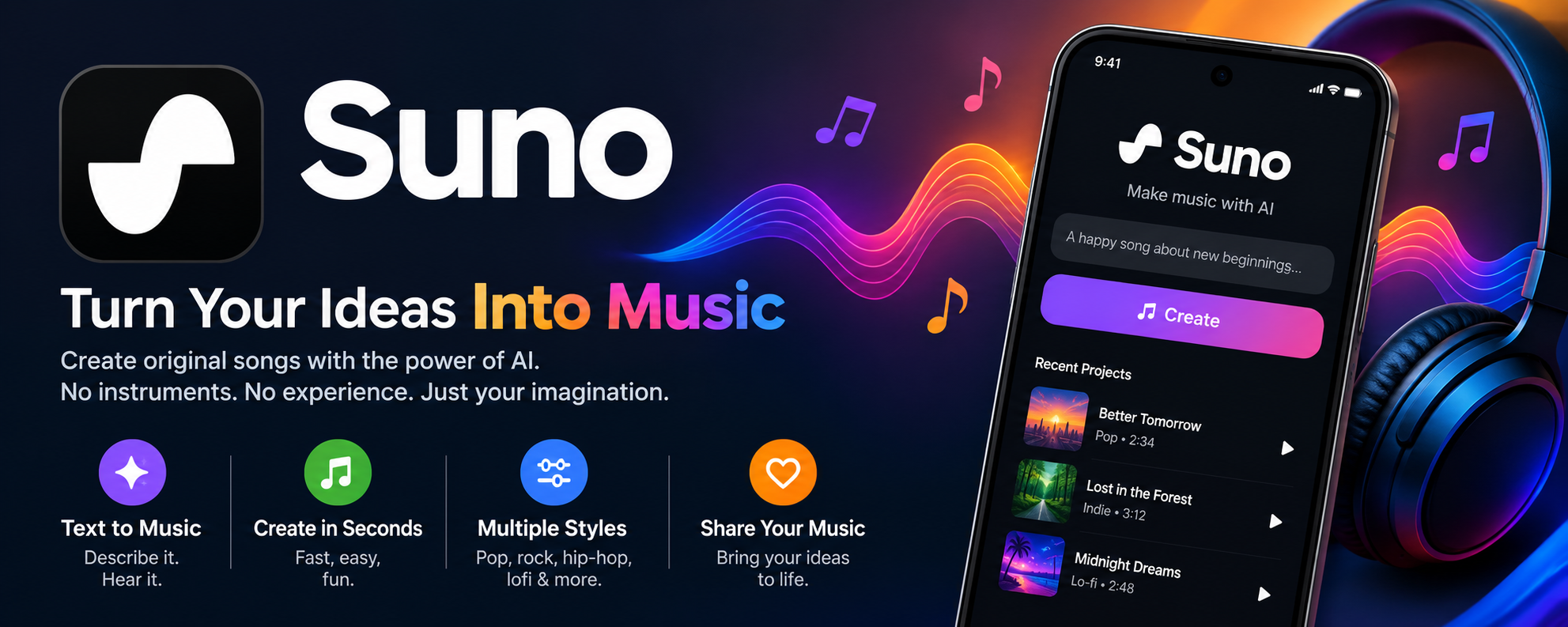
If you’ve ever hummed a melody in the shower and wished it could become a real song, Suno is built for exactly that fantasy. Available on Google Play and as a browser-based platform, Suno is an AI music generator that transforms text prompts, hummed melodies, or simple beats into complete, original songs—complete with vocals, lyrics, and instrumentation. You don’t need to know how to play an instrument, read sheet music, or even sing in tune. You just need an idea.
The app has exploded in popularity since its 2023 launch, with roughly seven million AI songs created on it every day. It supports an impressive range of genres—hip-hop, pop, rock, R&B, jazz, country, electronic, and more—and every song you generate is yours to keep, share, or even monetize (depending on your subscription tier).
How Suno Actually Works: From Prompt to Playlist
The core workflow is deceptively simple. You open the app, type a description like “a lo-fi monsoon love song” or “a jazz track about watering my plants,” and within seconds, Suno generates two complete song options with lyrics, vocals, and instruments. You can also upload your own audio or hum a melody to use as a starting point.
For those who want more control, Suno offers an Advanced Mode that separates lyrics from style prompts. This lets you write your own verses, specify BPM, mood, and reference artists, or leave the lyrics blank for an instrumental track. The platform also includes an AI lyrics generator that can turn anything—a group chat conversation, a study guide, a poem—into a song structure.
Here’s what you can do with Suno at a glance:
- Generate full songs from a single text prompt
- Write custom lyrics or let the AI handle them
- Choose from dozens of genres and subgenres
- Edit and remix individual sections of a track
- Separate stems (vocals, drums, bass) for deeper editing on paid plans
- Share and discover music in the Suno community feed
The Studio Advantage: When AI Meets a DAW
One of Suno’s most ambitious features is Suno Studio, a browser-based generative audio workstation that blurs the line between AI generation and traditional music production. Think of it as a lightweight DAW—similar to GarageBand or Logic Pro, but powered by AI.
Studio lets you work on individual stems, add new instrumental layers to existing tracks, align tempo for video projects, and even generate specific missing elements—like a deep bass layer or a percussion groove—without regenerating the entire song. You can download stems and MIDI data, which massively increases usability for producers who want to incorporate Suno’s output into their own workflows.
However, it’s not all smooth sailing. Reviewers note a steep mastery curve, inconsistent results, and some audio artifacts. Studio is technically still in beta and requires the top-tier Premier plan (around $18–$30/month depending on billing). For casual users, it’s overkill. For serious creators, it’s an intriguing glimpse of where AI-assisted music production is heading.
The Elephant in the Room: V6 and the Quality Debate
Here’s where the story gets complicated. In late 2026, Suno released its V6 model, developed in partnership with major record labels after licensing deals with Warner Music Group, BMG, and Believe. On paper, this was a step toward legitimacy—using only licensed training data instead of scraping the open internet.
In practice, many longtime users revolted. The Suno subreddit filled with complaints describing V6’s output as “muffled, dull, and strangely lifeless,” with vocals that sound “buried” and mixes that feel like “a blanket over the speakers”. One user who had published two albums with the previous V5.5 model said V6 produced “muffled, generic, soulless garbage by comparison”.
The irony isn’t lost on anyone: AI music critics have long dismissed generative music as soulless. Now, even AI music fans are using the same language—because the shift to licensed training data may have drastically restricted the model’s creative range. The exact scope of V6’s training data hasn’t been disclosed, but it’s undoubtedly smaller and less diverse than what previous models ingested from the open web.
For now, V5.5 remains the fan favorite for quality, while V6 represents Suno’s bet on a more legally sustainable—if creatively constrained—future.
Pricing: What You Get for Free (and What You Don’t)
Suno’s free tier is genuinely generous: 50 credits per day, which translates to roughly 10 songs daily, no credit card required. You get access to the free models, standard features, and can upload up to 8 minutes of audio.
But the free plan has significant limitations:
- No commercial rights—you can’t use your songs in monetized content
- No stem separation—you can’t isolate vocals or instruments
- No monthly song downloads—sharing is limited to the platform
- Shared creation queue—your generations take longer during peak times
Upgrading to Pro ($8–$10/month) unlocks 2,500 credits monthly, commercial use rights, 20 downloads per month, stem separation, and priority queue. The Premier plan ($30/month) is where Suno Studio lives, along with 10,000 credits, 60 downloads, MIDI export, and advanced stem separation.
One critical caveat: commercial rights are not retroactive. If you create a song on the free plan and later upgrade, you still don’t own the commercial rights to that original track. You must be subscribed when you create.
Real User Reviews: Praise, Frustration, and Feature Requests
The Google Play listing for Suno shows 2.45 million reviews, and the sentiment is decidedly mixed. A five-star review from “peach” praises the audio quality and genre diversity but begs for two things: a Chinese-language interface and Alipay integration, noting that international credit cards and PayPal are inaccessible for many global Chinese-speaking users.
On the frustration side, “Knight Jean” gave one star after a poor subscription and refund experience, writing that the company “almost has no effective appeal space” when refunds are denied. Another reviewer, “Jarvis Cocker,” offered a more constructive critique: he wants Suno to move beyond what feels like a “lottery” and build a more systematic music production framework involving AI agents, music theory, and acoustic analysis—turning unpredictable generation into something “analyzable, reproducible, and convergent.”
These reviews reveal a platform with passionate users who want it to succeed, but also one that struggles with localization, payment accessibility, and the fundamental unpredictability of AI generation.
Who Is Suno Actually For?
After reading the reviews and testing reports, a clear picture emerges. Suno is not a replacement for professional music production. It’s not going to write your next hit album, and it won’t satisfy producers who need surgical control over every frequency.
But for certain users, it’s genuinely transformative:
- Content creators who need royalty-free background music for YouTube, podcasts, or ads
- Songwriters stuck on a melody who want to hear their lyrics set to music instantly
- Hobbyists and bathroom singers who want to turn a shower thought into a shareable track
- Music educators looking for a low-barrier way to demonstrate song structure and genre conventions
One electronic music producer who tested Suno’s V5.5 model for melodic techno and Afro house admitted that the output was “pretty close to being as good as something you would hear on popular labels”—and that he couldn’t tell it was AI-generated. But he also said he didn’t enjoy making music this way. That tension—between impressive output and unsatisfying process—sits at the heart of the Suno experience.
The Road Ahead: Funding, Lawsuits, and What Comes Next
Suno raised **over $400 million in Series D funding** at a $5.4 billion valuation in mid-2026, led by Bond Capital with participation from major venture firms. The company is clearly betting big on AI music as a mainstream creative tool.
But legal clouds remain. While Suno settled with Warner Music Group, it’s still embroiled in lawsuits with Universal Music Group and Sony Music Entertainment. The shift to licensed training data—and the V6 backlash that followed—shows the impossible tension Suno faces: appease the music industry and lose the creative freedom that made the product exciting, or ignore the labels and risk existential legal jeopardy.